Cabo Verde’s history does not begin with an ancient civilization or a long pre-colonial timeline. The islands were uninhabited until the 15th century.
Positioned off the West African coast, Cabo Verde quickly became part of the early Atlantic world. Its history is shaped by movement of ships, people, and cultures rather than by a single origin story.
The early years: discovery and settlement
The islands were first recorded by Portuguese explorers in the 1460s. With no native population, settlement began soon after, bringing together Europeans and enslaved Africans.
This moment set the foundation for what Cabo Verde would become: a society formed through mixture, adaptation, and survival in a challenging environment.
- The first settlements developed on Santiago.
- The archipelago became a stop along transatlantic trade routes.
- Early life was shaped by scarcity, climate, and distance.
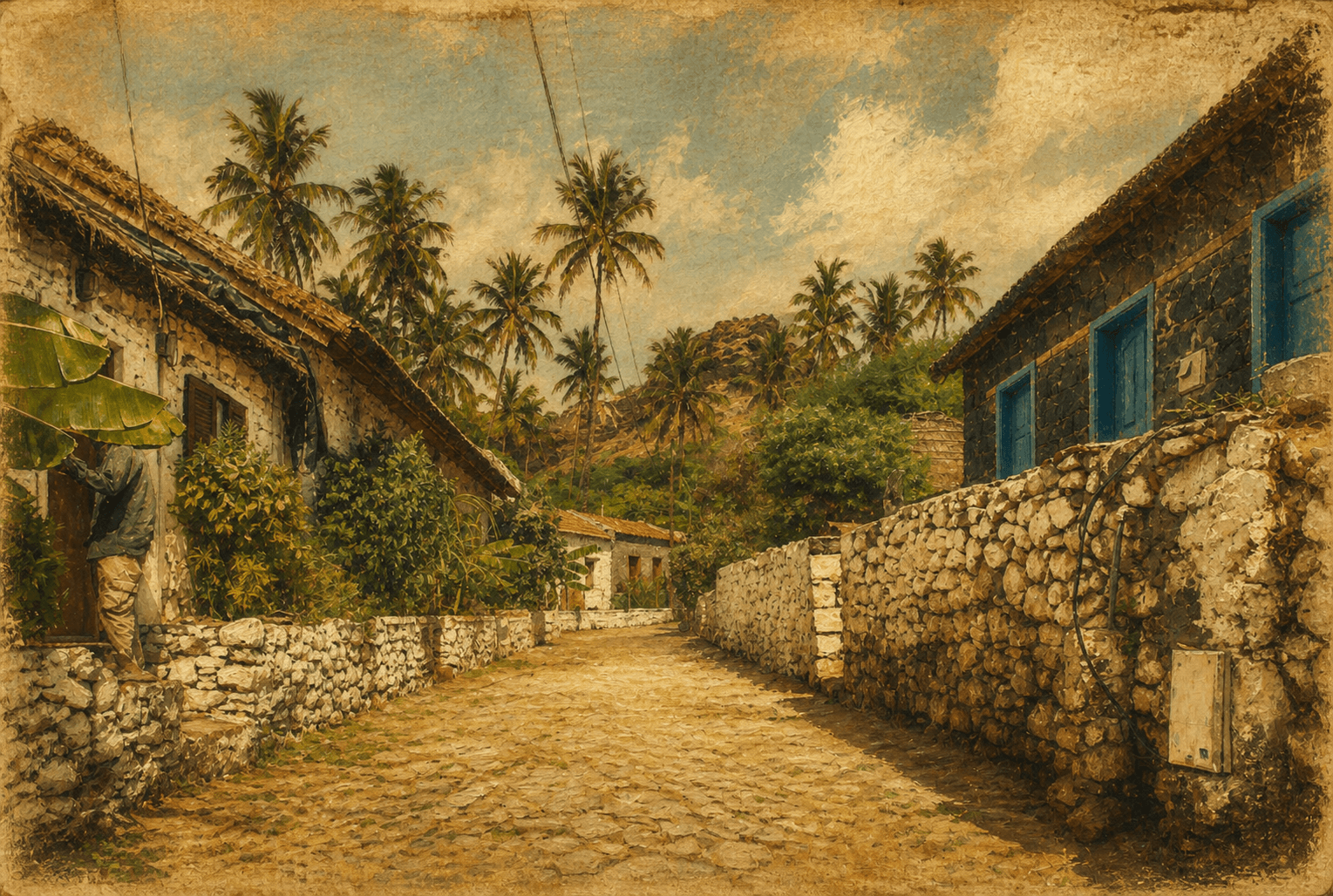
Cidade Velha, now a UNESCO World Heritage Site, stands as one of the earliest European colonial settlements in the tropics and reflects this period of formation.
A crossroads in the Atlantic
By the 16th century, Cabo Verde had become a key node in the transatlantic slave trade. Ships moving between Africa, Europe, and the Americas passed through the islands.
This role brought economic activity, but also hardship and instability.
- Periods of wealth were often followed by decline.
- Droughts and famine had lasting effects on the population.
- Many inhabitants emigrated, creating early patterns of diaspora.
What emerged over time was a culture deeply connected to both Africa and Europe, but distinct and unique from either.
Cabo Verde’s identity was not imported fully formed. It was built over time, through contact, constraint, and adaptation.
Culture takes shape
Despite economic challenges, a strong cultural identity developed across the islands.
Language, music, and daily life became expressions of this blended heritage:
- Kriolu evolved as the most widely spoken language.
- Music styles like morna and funaná reflect both African rhythms and Portuguese influences.
- Oral traditions, food, and social customs adapted to local realities.
This cultural formation is one of the most defining aspects of Cabo Verde today.
The path to independence
Like many African nations, Cabo Verde’s independence was tied to broader movements in the 20th century.
The struggle was closely linked with Guinea-Bissau, led in part by figures such as Amílcar Cabral, who advocated for liberation and cultural pride.
In 1975, Cabo Verde officially gained independence from Portugal.
- The transition was relatively peaceful compared to other regions.
- The new nation focused on stability, education, and governance.
- Over time, it developed a reputation for political consistency.
A modern identity shaped by movement
Today, Cabo Verde is defined as much by its diaspora as by its geography. More Cabo Verdeans live abroad than on the islands, creating a continuous exchange of culture, ideas, and support.
This global connection influences everything from music to business to daily life.
At the same time, each island feels grounded in its own landscape, history, and community.
What to remember
Cabo Verde’s history is not long in the traditional sense, but it is layered.
It is a story of arrival without origin, of hardship alongside creativity, and of identity built across oceans rather than within borders.
Understanding this history does not require memorising dates. It comes from recognising the patterns: movement, adaptation, and connection.
Those patterns are still visible across the islands today.
Continue exploring CVApp
Browse more stories in Culture or return to the full blog archive.